

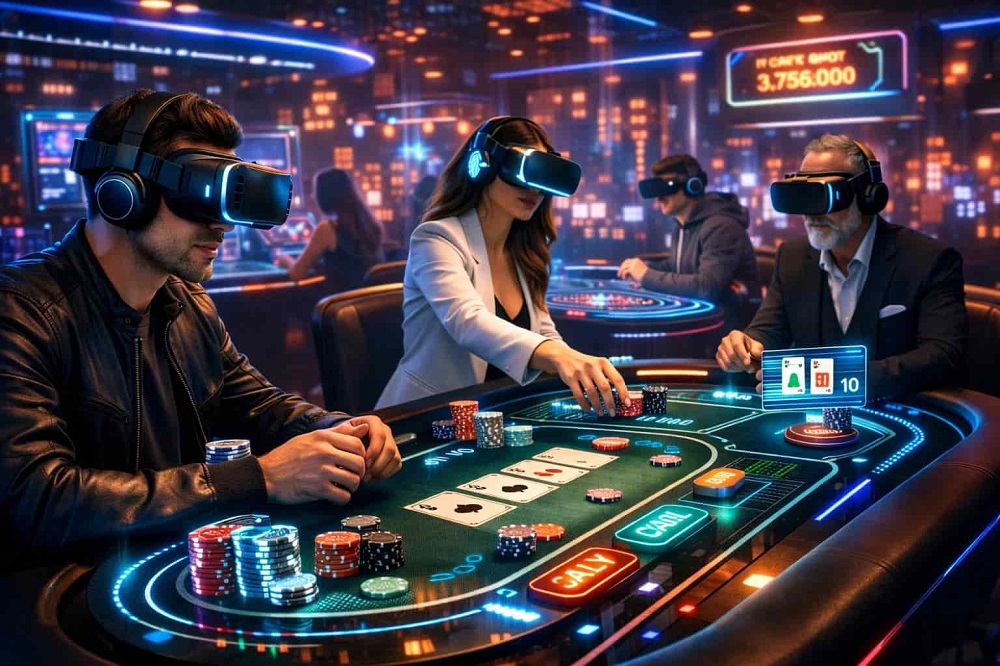
The online casino industry has historically operated at the leading edge of technological adoption. From the early days of basic web-based interfaces to the integration of live-dealer streaming services, digital gambling platforms have continuously sought ways to narrow the experiential gap between home convenience and land-based casino environments. Despite these advancements, standard desktop and mobile gaming experiences have remained limited by the two-dimensional nature of flat screens. Players remain outside observers, clicking buttons on a monitor or tapping glass displays to interact with their favorite games.
The deployment of virtual reality hardware and software frameworks represents a massive leap forward for the digital wagering sector. Virtual reality completely alters this dynamic by transforming the user from a passive spectator into an active participant embedded within a fully realized digital environment. By simulating spatial presence, physical mechanics, and real-time social dynamics, virtual reality technology is fundamentally reshaping consumer expectations, platform design, and the psychological framework of online casino gaming.
The Illusion of Spatial Presence and Environmental Immersion
The defining characteristic of virtual reality is spatial presence, the psychological sensation of actually being inside a digital space rather than merely looking at it through a window. In a standard online casino, a player looking at a digital slot machine sees a graphic interface overlaying a webpage. In a virtual reality casino, the player stands in front of a three-dimensional cabinet within a meticulously rendered, luxury gaming floor.
This environmental shift has a profound impact on player engagement. Developers can construct expansive virtual complexes complete with ambient background sounds, realistic architectural lighting, and animated crowds that mimic the exact sensory profile of a premier resort.
-
Exploration Mechanics: Players can physically walk through these virtual properties, moving from the slot aisles to high-stakes card rooms or lounge areas.
-
Sensory Restoration: The clinking of glasses, the distant murmur of other patrons, and the flashing lights of neighboring machines adapt dynamically as the user moves through the virtual space.
-
Focus Retention: Because the headset physically blocks out external real-world stimuli, distractions are completely minimized. The player focus is entirely dedicated to the virtual environment, leading to longer, more focused gaming sessions.
Restoring Natural Physicality and Intangible Mechanics
Traditional digital casino games rely entirely on abstract commands; a player clicks a mouse to deal a card, spin a wheel, or pull a lever. Virtual reality restores a sense of natural physicality to these digital actions, bridging the tactile disconnect that has characterized online gambling for decades.
Using motion-tracking controllers, a virtual reality casino player can physically reach out to pick up chips, stack them on a felt layout, and toss them onto a blackjack table. When playing craps, the player can pick up the virtual dice, shake them in their hand, and physically throw them down the length of a digital table, watching them bounce off the back wall in accordance with realistic physics engines.
In poker games, this physicality introduces an entirely new strategic layer. Players can physically look around the table to watch the real-time head and hand movements of their opponents. Sudden movements, hesitation when reaching for chips, or a rapid head turn toward a newly dealt community card can serve as organic physical tells, bringing the deep psychological bluffing mechanics of real-world poker into the digital space for the very first time.
Transforming Isolation into Social Interactivity
One of the longest-standing critiques of online gambling is its solitary nature. Standard digital casinos can feel isolating, with players interacting strictly with algorithms or text-based chat windows. Virtual reality re-establishes the critical social infrastructure that has made gambling a communal activity for centuries.
Within a virtual reality casino ecosystem, players choose and customize digital avatars that represent their physical presence in the room. These avatars utilize spatial voice technology, meaning that as you walk closer to another player or a dealer, their voice naturally grows louder, while distant conversations fade into background noise.
This enables spontaneous, organic social interactions. Players can chat casually with the person sitting next to them at a roulette table, celebrate a shared victory when a slot machine hits a major payout, or converse directly with a real-time host. This transformation of a solitary wagering portal into an active, multi-user social destination changes why consumers log onto the platform, driving retention through the desire for human connection rather than pure gambling mechanics.
Novel Game Architecture and Non-Traditional Gaming Formats
Virtual reality does not merely copy existing land-based casino layouts; it allows developers to break free from real-world physics and architectural limitations to create completely novel game formats. A virtual reality casino does not need to be housed in a standard brick-and-mortar building; it can sit on top of a floating cloud, inside an underwater dome, or within a futuristic sci-fi environment.
Furthermore, the mechanics of the games themselves are evolving. Instead of a standard flat slot display, a virtual reality slot machine can expand into a massive 360-degree bonus round that surrounds the player, forcing them to physically interact with flying objects or navigate a digital maze to unlock multipliers.
Card games can integrate real-time statistical overlays floating in the air next to the table, providing players with historical data or probability charts that update dynamically based on the game state. This hybridization of traditional gambling rules with the interactive freedom of advanced video game design attracts younger, tech-savvy demographics who demand multi-layered entertainment experiences.
Frequently Asked Questions
Do virtual reality casinos require expensive, high-end computer hardware to run properly?
While early virtual reality setups required powerful gaming computers, the modern landscape has shifted heavily toward standalone wireless headsets. Many virtual reality casino platforms are optimized to run directly on these self-contained devices without the need for a secondary computer connection, making the technology significantly more accessible and affordable for the average consumer.
How do virtual reality casino games ensure that their physical mechanics remain completely fair?
The physical actions you perform in virtual reality, such as throwing dice or spinning a wheel, are visual representations tied directly to certified software backends. The ultimate outcome of the action is still determined by a strictly audited random number generator or server-side algorithm, ensuring that the visual physics engine matches the precise mathematical odds required by regulatory frameworks.
Can I play virtual reality casino games using standard currency or is it limited to cryptocurrency?
Platform banking options vary by jurisdiction and operator. Many licensed virtual reality casinos integrate traditional payment methods, allowing you to fund your account and wager using standard government-issued currencies via credit cards, bank transfers, or electronic wallets, completely independent of cryptocurrency networks.
What measures do virtual reality casinos take to protect player safety and prevent motion sickness?
Developers utilize several optimization techniques to mitigate motion sickness, including maintaining high, consistent screen refresh rates and implementing teleportation-based movement controls rather than continuous artificial walking. Additionally, platforms feature built-in comfort settings that allow users to adjust field-of-view blinders and rotation increments to fit their personal tolerance levels.
Are traditional live-dealer games compatible with virtual reality headset environments?
Yes, developers have created hybrid formats where live-dealer video streams are mapped into three-dimensional virtual environments. In these setups, the dealer sits at a physical table captured by specialized stereoscopic cameras, allowing a headset user to see the real human dealer in full 3D while sitting at a virtual table surrounded by other digital avatars.
How do virtual reality platforms handle abusive or disruptive behavior from other player avatars?
Virtual reality casinos implement robust personal space guardrails and moderation tools. Players can activate a personal bubble setting that renders their avatar invisible or intangible if another user gets too close. Furthermore, players have the immediate ability to mute, block, or report disruptive individuals, removing them from their personal view instantly.
Is it possible to play virtual reality casino games with friends in private rooms?
Many modern virtual reality casino applications feature private lobby systems. Users can create private tables for games like poker or blackjack and invite specific individuals from their friend list, allowing groups to gather digitally from different geographic locations to enjoy an exclusive, private gaming session together.
